Trusted by 5,000+ Businesses Worldwide

Product Development Consulting Services

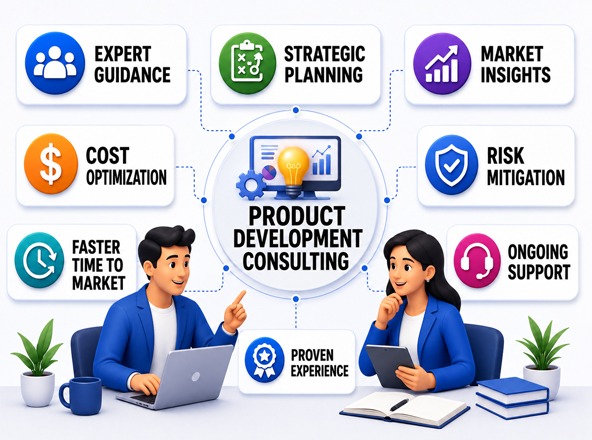
Web Brain InfoTech, based in Delhi, India, provides product development consulting services for businesses and founders across India and worldwide. Product development consulting addresses the strategic and process decisions that determine whether a digital product succeeds commercially — from initial concept validation through to product-market fit, scalable architecture, and go-to-market execution.

★★★★★ 4.9/5 rating from 19,000+ verified reviews

Get a Free Project Quote

Product Development Consulting Team
Why WebBrain

Product Development Consulting Company in Delhi, India

Building a product without consulting is like constructing a building without an architect: the technical workers may be skilled, but the structural decisions made without informed planning become expensive to correct once construction is underway.

Web Brain InfoTech delivers product development consulting services to clients in Delhi NCR, across India, and internationally, including the United States, United Kingdom, UAE, Canada, and Australia.

What Is Product Development Consulting?

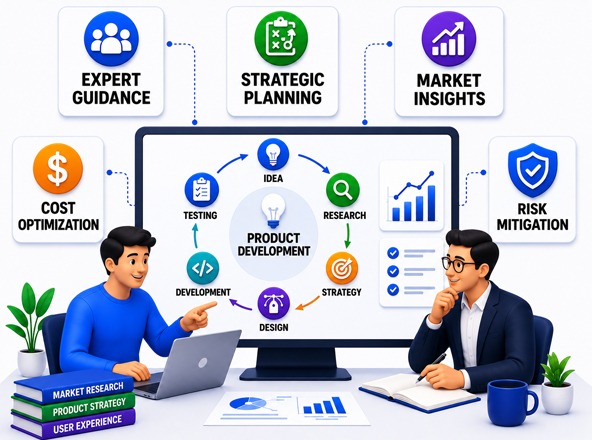
Product development consulting is advisory work that helps businesses, product teams, and founders make better decisions across the full spectrum of digital product creation — from validating the initial concept through technology selection, team structure, delivery methodology, and growth strategy.

Product Discovery and Validation

Testing whether a product concept addresses a real problem with sufficient market demand before committing to full development

Product Roadmap Development

Prioritizing features and milestones based on business objectives, user needs, and technical constraints

Technology Selection and Architecture Advisory

Recommending the right technology stack and architecture for the product's requirements

MVP Scoping and Definition

Defining the minimum viable product that tests the core hypothesis without overbuilding

Go-to-Market Strategy

Advising on launch approach, pricing model, and user acquisition strategy

Product-Market Fit Assessment

Diagnosing whether an existing product is achieving market resonance and identifying adjustments

Agile Process and Team Structure Advisory

Helping teams adopt delivery practices suited to the specific product and organization

Build vs. Buy vs. License Analysis

Assessing whether specific product components should be built, purchased as SaaS, or licensed

Consulting engagements produce decisions and plans, not code. They are the front-end investment that makes subsequent development spend more efficient and better targeted.

When Does a Business Need Product Development Consulting?

Product development consulting delivers the most value at high-stakes decision points, where uninformed choices cost significantly more to correct than the cost of the consulting engagement itself.

Before Starting a New Digital Product

Validating the concept, defining scope, and selecting technology before committing a development budget

When Development Has Stalled or Gone Over Budget

Diagnosing whether the problem is scope, team, architecture, or process

When an Existing Product Has Plateaued in Growth

Assessing whether the product, positioning, or go-to-market approach needs adjustment

When Evaluating a Potential Technology Partner

Independently reviewing proposals, timelines, and cost estimates from development vendors

When Scaling from MVP to Production

Advising on the architectural and process changes needed to move from a validated prototype to a scalable platform

When Restructuring a Product Organization

Recommending team structures, roles, and delivery methodologies suited to the product's current stage

When a Product Has Been Acquired or Inherited

Assessing its technical and commercial state before committing to ongoing investment

Each scenario represents a moment where informed, independent advice reduces the risk of costly decisions made with incomplete information.

What Product Development Consulting Services Does Web Brain InfoTech Offer?

We provide structured consulting engagements across the key decision domains of digital product development.

Product Discovery and Concept Validation

Running structured discovery processes to test whether a product concept addresses a real problem, including user research, competitor analysis, and demand validation before development investment.

MVP Definition and Scope Advisory

Defining the minimum viable product — the smallest version of the product that can validate the core hypothesis with real users — and prioritizing features against that scope.

Product Roadmap Development

Building a prioritized, time-sequenced product roadmap that balances user needs, business objectives, technical feasibility, and resource constraints.

Technology Stack and Architecture Advisory

Recommending appropriate technology choices and architectural patterns for the product's specific requirements, scale, and team capabilities.

Build vs. Buy vs. License Analysis

Evaluating whether specific product capabilities should be built from scratch, purchased as SaaS products, or licensed from third-party providers.

Product-Market Fit Assessment

Diagnosing whether an existing product is achieving commercial resonance and identifying the most likely adjustments to improve adoption and retention.

Agile and Lean Process Advisory

Recommending and supporting adoption of product delivery methodologies — Scrum, Kanban, Shape Up, or hybrid approaches — suited to the team and product context.

Vendor and Development Partner Evaluation

Independently reviewing development agency proposals, assessing technical credibility, and advising on engagement structure.

Our Process

How Does Web Brain InfoTech Approach Product Development Consulting?

Our consulting process is structured to produce clear, prioritized, implementable recommendations rather than generic frameworks.

01
Scope and Goal Definition

Understanding the specific decision the engagement needs to resolve and what a successful outcome looks like

02
Stakeholder and Context Immersion

Reviewing existing documentation, product analytics, user research, and competitive intelligence relevant to the decision

03
Current State Diagnosis

Assessing the current product, team, process, or technology against the goals defined in step one

04
Option Mapping and Evaluation

Identifying available paths forward and evaluating each against defined criteria

05
Recommendation Development

Producing specific, prioritized recommendations with rationale rather than generic options

06
Roadmap and Implementation Planning

Sequencing recommended actions into a realistic delivery plan

07
Optional Implementation Support

Transitioning into development, design, or ongoing advisory roles when the engagement confirms that need

This process is adaptable to engagements lasting days (a focused technology selection) through months (a full product strategy development).

What Is the Difference Between Product Development Consulting and Software Development?

This distinction matters when deciding what type of partner is needed.

Product Development Consulting Produces

Product strategy documents
Validated product concepts and feature priorities
Technology and architecture recommendations
Go-to-market plans
Vendor evaluation reports
Roadmaps and delivery plans

Software Development Produces

Working software, applications, and platforms
Implemented features and integrations
Deployed infrastructure

Consulting answers the question "what should we build and how?" Development answers the question "build it." Many clients engage Web Brain InfoTech for both, with consulting preceding and informing development, but each service is available independently.

What Frameworks and Methodologies Are Used in Product Consulting?

Effective product consulting draws on established frameworks adapted to the specific context rather than applied as rigid templates.

Design Thinking

Structured problem-solving focused on user empathy, problem definition, ideation, prototyping, and testing

Jobs-to-be-Done (JTBD)

Understanding what customers are trying to accomplish rather than what features they say they want

Lean Startup Methodology

Build-measure-learn cycles for validating product hypotheses with minimum investment

OKRs (Objectives and Key Results)

Aligning product development priorities with measurable business outcomes

RICE Prioritization Framework

Scoring features by Reach, Impact, Confidence, and Effort for roadmap prioritization

MoSCoW Method

Classifying requirements as Must-have, Should-have, Could-have, and Won't-have for MVP scoping

Shape Up (Basecamp)

Fixed-time, variable-scope delivery methodology for product teams

Wardley Mapping

Strategic technology positioning and build vs. buy decision-making

Product-Led Growth (PLG)

Designing the product itself as the primary user acquisition and retention mechanism

These frameworks are applied selectively based on the specific consulting context, not uniformly across every engagement.

What Is MVP Development and How Does Consulting Define It?

Minimum viable product (MVP) definition is one of the most common and most misapplied concepts in product development. Consulting clarifies what an MVP actually is and isn't.

What an MVP Is

The smallest version of a product that delivers genuine value to a defined user group and generates meaningful feedback about whether the core product hypothesis is correct.

What an MVP Is Not

A rough prototype, a demo, or a feature-incomplete product that cannot be used for real purposes. An MVP must be viable — usable in real conditions by real users — to generate the learning it is intended to create.

Common MVP Definition Mistakes That Consulting Prevents

Overbuilding

Including "nice-to-have" features that don't test the core hypothesis

Underbuilding

To the point where the product can't validate anything because it's too limited

Engineering Convenience

Defining MVP by engineering convenience rather than learning objectives

Confusing with PoC

Confusing an MVP with a pilot or proof-of-concept, which serve different purposes

Web Brain InfoTech's MVP scoping process starts from the hypothesis being tested, not from a feature list, and works backward to the minimum that genuinely tests it.

Web Brain Team

Why Choose Web Brain InfoTech for Product Development Consulting?

Product consulting grounded in hands-on development experience across multiple product types
Technology-agnostic platform and architecture recommendations based on actual requirements
MVP scoping discipline informed by what genuinely gets products to market efficiently
Understanding of both Indian startup product context and international product development standards
Ability to transition from consulting recommendations into development execution when the engagement leads there
Transparent, bounded engagements with defined deliverables and timelines
No vendor lock-in on technology recommendations — the right tool for the product, not the one Web Brain InfoTech prefers to develop in
Got Questions?

Frequently Asked Questions

Straight answers about Product Development Consulting Services.

Product management is an ongoing internal function responsible for defining, prioritizing, and guiding product development continuously. Product development consulting is external advisory work engaged for specific decisions, assessments, or planning activities, typically time-bounded rather than continuous.

Engagement length depends entirely on scope. A focused MVP scoping or technology selection exercise may take one to two weeks. A comprehensive product strategy or go-to-market planning engagement typically takes four to eight weeks.

Yes. Many engagements begin with consulting that defines scope, technology, and roadmap, then transition naturally into development execution. The consulting output directly informs the development brief, making the transition more efficient than starting a development project without prior strategic clarity.

Product-market fit is the state in which a product is serving a market with sufficient demand that growth becomes natural and retention is strong. Consulting helps identify which signals indicate current fit or its absence, and prioritizes the changes most likely to move toward it.

A proof of concept tests technical feasibility — can this be built. An MVP tests commercial viability — will users use and pay for this. They serve different purposes and are evaluated by different criteria.

No. Enterprise teams, established businesses launching new digital products, and organizations modernizing existing systems all benefit from structured product consulting. The specific focus areas differ by organizational context, but the core discipline applies across company sizes.

Yes. Non-disclosure agreements are standard for all consulting engagements involving proprietary product concepts, business strategy, or competitive positioning.

Ready to Build Your Dream Web Portal?

Book a free strategy call and discover how Web Brain can scale your business with secure, interactive portals.

Chat with Us
Call Us +91-782 774 2414 Chat on WhatsApp
We're Hiring