Trusted by 5,000+ Businesses Worldwide

Cloud Native Application Development

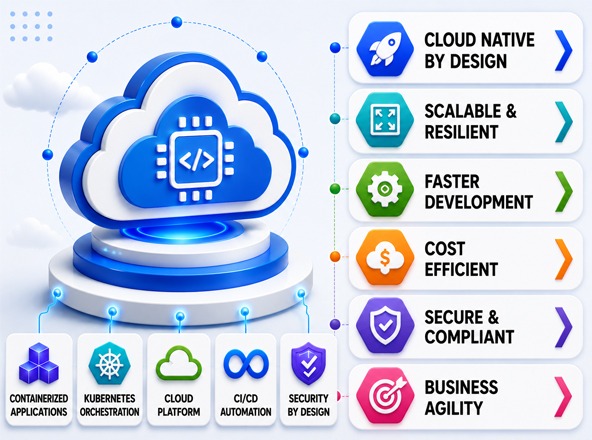
Web Brain InfoTech, based in Delhi, India, builds cloud native applications for businesses across India and worldwide. Cloud native application development is the discipline of designing software specifically to exploit the elasticity, resilience, and managed services of cloud infrastructure.

★★★★★ 4.9/5 rating from 19,000+ verified reviews

Get a Free Cloud Native Project Quote

Cloud Native Application Development Team
Why WebBrain

Cloud Native Application Development Company in Delhi, India

Cloud native is an architectural philosophy encompassing microservices, containers, dynamic orchestration, and declarative infrastructure, formalized and stewarded by the Cloud Native Computing Foundation (CNCF). Applications built cloud native from the start scale more predictably, recover from failure more gracefully, and evolve more easily than applications retrofitted onto cloud infrastructure.

Web Brain InfoTech delivers cloud native application development services to clients in Delhi NCR, across India, and internationally, including the United States, United Kingdom, UAE, Canada, and Australia.

What Is Cloud Native Application Development?

Cloud native application development is the practice of building software applications specifically designed to run in cloud environments, taking full advantage of on-demand scalability, managed infrastructure services, and distributed system resilience patterns that traditional server-based applications are not architected to use.

Containerization

Packaging applications and their dependencies into portable, consistent containers using Docker

Microservices Architecture

Decomposing applications into independently deployable, loosely coupled services

Dynamic Orchestration

Using Kubernetes to automate deployment, scaling, and management of containerized services

Declarative Infrastructure

Defining infrastructure and deployment state declaratively rather than through manual configuration

Resilience Patterns

Circuit breakers, retries, and graceful degradation designed to handle distributed system unreliability

Observability

Comprehensive logging, metrics, and distributed tracing designed into the system from the start

These principles are formalized by the Cloud Native Computing Foundation (CNCF), which stewards foundational open-source projects including Kubernetes, Prometheus, and Envoy.

How Is Cloud Native Different From "Cloud Hosted"?

This distinction is frequently misunderstood, and it matters significantly for the benefits an organization actually realizes from moving to the cloud.

Aspect Cloud Hosted (Lift and Shift) Cloud Native
Architecture Traditional monolith moved to cloud VMs Containerized microservices designed for cloud
Scaling Manual or basic auto-scaling of whole app Granular, automated scaling per service
Resilience Depends on VM uptime Self-healing via orchestration
Deployment Infrequent, larger releases Frequent, incremental, automated releases
Infrastructure management Often manual configuration Declarative Infrastructure as Code
Portability Often cloud-provider specific Portable across cloud providers via containers

An application simply hosted on cloud virtual machines without architectural changes captures only a fraction of the benefits that genuine cloud native design delivers.

What Cloud Native Development Services Does Web Brain InfoTech Offer?

We provide complete cloud native application development covering containerization, orchestration, and the surrounding operational tooling.

Architecture Design

Designing microservices boundaries, container strategy, and orchestration approach for new or migrating applications

Containerization & Docker

Building optimized, secure Docker images and multi-stage build pipelines for application components

Kubernetes Deployment

Designing and deploying Kubernetes clusters, Helm charts, auto-scaling (HPA/VPA), and cluster management

Service Mesh Implementation

Implementing Istio or Linkerd for traffic management, mutual TLS security, and observability

CI/CD & GitOps

Building automated pipelines using GitHub Actions, GitLab CI, or ArgoCD with GitOps practices

Observability Stack

Implementing Prometheus, Grafana, and distributed tracing (Jaeger) for comprehensive monitoring

We also handle cloud native migration of existing monolithic applications and Infrastructure as Code using Terraform or Pulumi.

What Technologies Are Used in Cloud Native Application Development?

Cloud native development draws on a well-established ecosystem of CNCF-stewarded and complementary open-source and managed cloud technologies.

Containerization

Docker, Podman, Buildpacks

Orchestration

Kubernetes, Amazon EKS, Google GKE, Azure AKS

Service Mesh

Istio, Linkerd, Consul

CI/CD & GitOps

GitHub Actions, GitLab CI, ArgoCD, Flux, Jenkins

Observability

Prometheus, Grafana, Jaeger, OpenTelemetry, ELK Stack

Infrastructure as Code

Terraform, Pulumi, AWS CloudFormation, Helm

What Are the Twelve-Factor App Principles?

The Twelve-Factor App methodology, originally articulated by Heroku, remains a foundational reference for cloud native application design, describing the characteristics that make applications portable, scalable, and maintainable in cloud environments.

The Twelve Factors

  1. Codebase — One codebase tracked in version control, deployed to multiple environments
  2. Dependencies — Explicitly declared and isolated dependencies
  3. Config — Configuration stored in environment variables, not in code
  4. Backing services — Treating databases, queues, and caches as attached resources accessed via URLs
  5. Build, release, run — Strict separation between build, release, and run stages
  6. Processes — Executing the app as stateless processes
  7. Port binding — Exporting services via port binding
  8. Concurrency — Scaling out via the process model
  9. Disposability — Fast startup and graceful shutdown
  10. Dev/prod parity — Keeping development, staging, and production as similar as possible
  11. Logs — Treating logs as event streams
  12. Admin processes — Running administrative tasks as one-off processes

These principles predate but remain highly compatible with modern cloud native architecture based on containers and Kubernetes.

What Are the Key Components of a Cloud Native Architecture?

A cloud native application typically comprises several distinct architectural layers, each addressing a specific concern within the overall system.

Containerization Layer

Applications are packaged with Docker into containers, ensuring consistent behavior across development, staging, and production environments.

Orchestration Layer

Kubernetes manages container deployment, scaling, networking, and self-healing across a cluster of machines.

Service Mesh Layer

Tools like Istio or Linkerd manage service-to-service communication, providing traffic management, security, and observability.

Observability Layer

Prometheus, Grafana, Jaeger/Zipkin, and ELK/EFK stack provide comprehensive system visibility.

Additional layers include API Gateway (Kong, Ambassador) and Infrastructure as Code (Terraform, Pulumi).

How Does Web Brain InfoTech Approach Cloud Native Application Development?

Our cloud native development process is structured to build systems that are resilient, observable, and scalable by design rather than retrofitted after deployment issues emerge.

1. Architecture Assessment

Evaluating whether the application's requirements genuinely benefit from cloud native patterns

2. Service Decomposition

Defining microservices boundaries aligned to business domains

3. Containerization Strategy

Designing Docker image structure, base images, and build optimization

4. Orchestration Design

Configuring Kubernetes cluster architecture, namespaces, and resource policies

5. CI/CD Pipeline

Building automated build, test, and deployment pipelines with appropriate gating

6. Observability & Resilience

Building metrics, logging, tracing, and validating system behavior under failure conditions

Why Choose Web Brain InfoTech for Cloud Native Application Development?

Web Brain InfoTech brings hands-on Kubernetes, containerization, and cloud native operational experience to application development projects.

Kubernetes Expertise

Deployment and management across AWS EKS, Google GKE, and Azure AKS

Service Mesh Experience

Implementation experience with Istio and Linkerd

GitOps & CI/CD

Pipeline engineering for reliable, automated deployment

Observability-First Design

Prometheus, Grafana, and distributed tracing from the start

Infrastructure as Code

Terraform discipline for reproducible environments

Honest Assessment

When cloud native is justified versus when simpler approaches better serve the application

We work with SaaS companies, enterprises modernizing legacy infrastructure, and growth-stage businesses building applications designed to scale reliably from the start.

Got Questions?

Frequently Asked Questions

Straight answers about Cloud Native Application Development Services.

A cloud-based application simply runs on cloud infrastructure, potentially as a traditional monolith moved onto cloud virtual machines. A cloud native application is architected from the ground up using containers, microservices, and orchestration to exploit the specific capabilities of cloud environments, including elastic scaling and self-healing.

Kubernetes is the most widely adopted orchestration platform for cloud native applications and is a core CNCF project, but cloud native principles can also be applied using other orchestration approaches or managed container services, though Kubernetes has become the de facto standard.

The CNCF is a Linux Foundation project that hosts and stewards open-source cloud native technologies, including Kubernetes, Prometheus, Envoy, and many other foundational projects, providing governance and community structure for the cloud native ecosystem.

Not always. Cloud native architecture introduces operational complexity that is only justified when an application's scale, team size, or resilience requirements benefit from it. Small applications with modest traffic are often better served by simpler architectures until genuine scaling needs emerge.

GitOps is a practice where the desired state of infrastructure and application deployments is declared in a Git repository, and automated tooling (like ArgoCD or Flux) continuously reconciles the actual system state to match the declared state, providing an auditable, version-controlled deployment process.

Yes. Migration can be incremental, starting with containerizing the existing application, then gradually extracting services into independently deployable components, rather than requiring a complete rewrite before realizing any cloud native benefits.

Yes. We provide ongoing Kubernetes cluster management, CI/CD pipeline maintenance, observability monitoring, and platform evolution support after the initial cloud native application is deployed.

Ready to Build Your Dream Web Portal?

Book a free strategy call and discover how Web Brain can scale your business with secure, interactive portals.

Chat with Us
Call Us +91-782 774 2414 Chat on WhatsApp
We're Hiring