Trusted by 5,000+ Businesses Worldwide

Cloud Migration Services

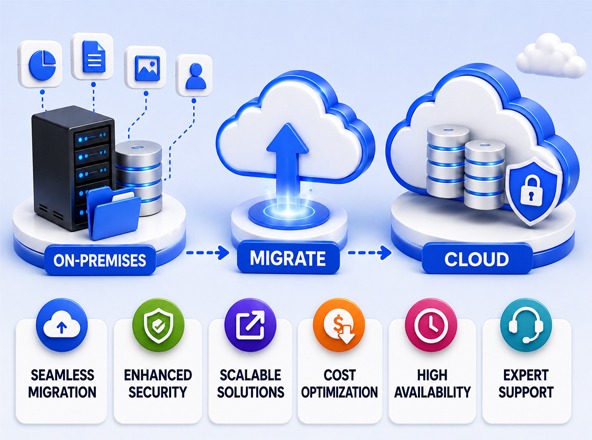
Web Brain InfoTech, based in Delhi, India, provides cloud migration services for businesses across India and worldwide. Cloud migration is the process of moving applications, data, and infrastructure from on-premises data centers or legacy hosting environments to cloud platforms such as AWS, Microsoft Azure, or Google Cloud, with the specific migration strategy determined by the application's current architecture, business constraints, and target outcomes.

★★★★★ 4.9/5 rating from 19,000+ verified reviews

Get a Free Cloud Migration Project Quote

Cloud Migration Services Team
Why WebBrain

Cloud Migration Services Company in Delhi, India

Cloud migration is fundamentally a business risk management exercise as much as a technical project. Poorly planned migrations result in downtime, data loss, cost overruns, and performance regressions. Well-planned migrations reduce infrastructure cost, improve reliability, and position the organization for future cloud native modernization.

Web Brain InfoTech delivers cloud migration services to clients in Delhi NCR, across India, and internationally, including the United States, United Kingdom, UAE, Canada, and Australia.

What Is Cloud Migration?

Cloud migration is the process of moving digital assets — applications, databases, workloads, and IT infrastructure — from on-premises servers or one cloud environment to another, typically to a public cloud platform such as AWS, Microsoft Azure, or Google Cloud Platform (GCP).

Infrastructure Migration

Moving servers, storage, and networking configurations to cloud equivalents

Application Migration

Moving software applications to run in cloud environments, with varying degrees of modification

Database Migration

Moving databases to cloud-managed database services with minimal downtime

Data Migration

Transferring existing data assets to cloud storage while maintaining integrity and accessibility

Legacy System Migration

Moving older, on-premises systems to modern cloud infrastructure, often requiring modernization alongside the move

Cloud-to-Cloud Migration

Moving workloads between cloud providers for cost, feature, or strategic reasons

Each migration type carries different technical approaches, risk profiles, and timeline expectations. Hybrid cloud transition — migrating select workloads to the cloud while maintaining others on-premises for compliance or latency reasons — is also a core area.

What Are the 6 R's of Cloud Migration?

The "6 R's" framework, popularized by AWS and widely adopted across the industry, categorizes the strategic approaches available for migrating any given application or workload to the cloud.

Strategy Description
Rehost ("Lift and Shift") Moving an application to the cloud with minimal or no code changes, typically by migrating virtual machines directly to cloud compute instances. Fastest migration approach, but captures the least cloud-native benefit.
Replatform ("Lift, Tinker, and Shift") Making limited cloud optimizations during migration without changing the application's core architecture — for example, moving a database to a managed cloud database service while keeping the application logic unchanged.
Repurchase Replacing an existing application with a cloud-based commercial alternative, typically a SaaS product, rather than migrating the existing system.
Refactor / Re-architect Substantially redesigning the application to take full advantage of cloud native capabilities — containers, microservices, serverless — during the migration. Highest effort and cost, but captures the greatest long-term benefit.
Retire Decommissioning applications that are no longer needed, reducing the overall migration scope and simplifying the target environment.
Retain Keeping certain applications on-premises where migration doesn't provide sufficient benefit or where compliance, latency, or technical constraints prevent migration in the current planning cycle.

Most enterprise migrations apply a mix of these strategies across their application portfolio rather than a single approach uniformly.

What Are the Key Phases of a Cloud Migration Project?

A structured cloud migration follows a defined sequence of phases designed to reduce risk and maintain business continuity throughout the transition.

Phase 1: Assessment and Discovery

Cataloging existing applications, infrastructure, dependencies, and data. Assessing each application's migration complexity and assigning an appropriate 6 R's strategy.

Phase 2: Migration Strategy and Planning

Defining the target cloud architecture, migration sequence, timeline, and rollback plans. Establishing success criteria and identifying migration risks.

Phase 3: Cloud Environment Setup

Provisioning the target cloud environment, including networking (VPC configuration), security groups, identity and access management (IAM), and foundational infrastructure.

Phase 4: Pilot Migration

Migrating a low-risk, representative application first to validate the migration process, tooling, and target environment configuration before scaling to critical systems.

Phase 5: Data Migration

Moving databases and data assets using appropriate tools, often with continuous replication to minimize downtime during cutover.

Phase 6: Application Migration Execution

Migrating applications according to the defined sequence, using rehosting tools, containerization, or refactoring as appropriate for each workload.

Phase 7: Testing and Validation

Validating functionality, performance, security, and data integrity in the new environment before directing production traffic to it.

Phase 8: Cutover and Go-Live

Switching production traffic to the new cloud environment, typically using DNS cutover or traffic shifting strategies to minimize disruption.

Phase 9: Post-Migration Optimization

Right-sizing cloud resources, optimizing costs, and addressing any performance issues identified after go-live.

What Cloud Migration Services Does Web Brain InfoTech Offer?

We provide end-to-end cloud migration services covering assessment, execution, and post-migration optimization.

Cloud Migration Assessment and Readiness Analysis

Cataloging existing applications and infrastructure, assessing migration complexity, and recommending the appropriate 6 R's strategy for each workload.

Migration Strategy and Roadmap Development

Defining target cloud architecture, migration sequencing, timeline, and risk mitigation plans.

Rehosting and Lift-and-Shift Migration

Moving virtual machines and applications to cloud compute instances using tools like AWS Application Migration Service (MGN), Azure Migrate, or Google Cloud Migrate.

Database Migration

Migrating databases to managed cloud database services (Amazon RDS, Azure SQL Database, Google Cloud SQL) using tools like AWS Database Migration Service (DMS) with minimal downtime.

Application Refactoring for Cloud

Re-architecting applications to adopt containers, microservices, and cloud native patterns during migration for maximum long-term benefit.

Legacy System Migration and Modernization

Migrating older on-premises systems to modern cloud infrastructure, often combined with application modernization to address technical debt.

Multi-Cloud and Cloud-to-Cloud Migration

Migrating workloads between cloud providers or implementing multi-cloud architecture for redundancy or cost optimization.

Post-Migration Cost and Performance Optimization

Right-sizing cloud resources, implementing reserved instances or savings plans, and optimizing architecture based on real production usage patterns.

How Does Web Brain InfoTech Approach Cloud Migration?

Our migration process is structured to minimize business disruption while maximizing the value captured from the move to cloud infrastructure.

1. Discovery and Application Portfolio Assessment

Cataloging all applications, dependencies, and infrastructure in scope for migration

2. 6 R's Strategy Assignment

Determining the appropriate migration approach for each application based on its business criticality and technical characteristics

3. Target Architecture Design

Designing the cloud environment including networking, security, and identity management

4. Migration Wave Planning

Sequencing applications into migration waves based on dependencies, risk, and business priority

5. Pilot Migration

Validating the migration approach with a low-risk application before scaling

6. Data Migration Execution

Moving databases and data assets with appropriate replication and validation

7. Application Migration Execution

Executing the planned migration approach for each application wave

8. Testing and Validation

Verifying functionality, performance, and data integrity before cutover

9. Production Cutover

Switching live traffic to the new cloud environment with rollback plans in place

10

10. Post-Migration Optimization

Right-sizing resources and addressing performance or cost issues identified after go-live

This phased approach applies to full data center migrations and to migrating individual applications or workloads.

What Tools Are Used in Cloud Migration?

Cloud migration relies on both provider-native migration tools and third-party platforms for different migration scenarios.

AWS Migration Tools

AWS Application Migration Service (MGN) — automated lift-and-shift server migration; AWS Database Migration Service (DMS) — database migration with minimal downtime; AWS DataSync — infrastructure and data migration; AWS Migration Hub — centralized migration tracking across tools

Azure Migration Tools

Azure Migrate — assessment and migration orchestration for VMs, databases, and web apps; Azure Database Migration Service — database migration to Azure SQL and managed databases; Azure Site Recovery — replication-based migration and disaster recovery

Google Cloud Migration Tools

Google Cloud Migrate for Compute Engine — VM migration to GCP; Google Database Migration Service — managed database migration

Third-Party and Open-Source Tools

CloudEndure (AWS-owned) — continuous replication-based migration; HashiCorp Terraform — Infrastructure as Code for provisioning target cloud environments; Ansible — configuration management for consistent environment setup

What Are the Common Risks in Cloud Migration and How Are They Managed?

Cloud migration projects carry specific risks that require deliberate mitigation strategies throughout the project.

Downtime During Cutover

Mitigated through continuous data replication, blue-green deployment strategies, and detailed rollback plans

Data Loss or Corruption

Mitigated through validated backup procedures, checksums, and parallel-run validation before decommissioning source systems

Unexpected Cost Overruns

Mitigated through detailed cost modeling before migration and continuous cost monitoring after go-live

Application Compatibility Issues

Mitigated through thorough pre-migration testing in a staging cloud environment

Security Misconfiguration

Mitigated through infrastructure as code, security review, and adherence to cloud provider security best practices (AWS Well-Architected Framework, Azure Well-Architected Framework)

Underestimated Migration Complexity

Mitigated through thorough discovery and dependency mapping before committing to a migration timeline

Staff and Stakeholder Resistance

Mitigated through clear communication, training, and phased rollout that demonstrates value incrementally

Web Brain InfoTech addresses these risks through structured planning, pilot migrations, and conservative rollback planning at every migration phase.

Why Choose Web Brain InfoTech for Cloud Migration?

Web Brain InfoTech brings structured migration methodology and hands-on cloud platform experience to migration projects of varying scale and complexity.

Multi-Cloud Experience

Experience across AWS, Microsoft Azure, and Google Cloud migration tooling and services

Structured 6 R's Assessment

Structured 6 R's assessment methodology for accurate migration strategy per application

Database Migration Expertise

Database migration expertise for minimal-downtime cutover of production systems

Migration + Modernization

Combined migration and modernization capability, refactoring applications toward cloud native architecture where valuable

Cost Optimization Focus

Cost optimization focus, ensuring migrated workloads are right-sized rather than simply relocated at the same cost

Transparent Project Management

Transparent project management with detailed migration wave planning and risk tracking

We work with enterprises migrating from legacy data centers, businesses consolidating from multiple cloud providers, and organizations modernizing outdated on-premises infrastructure.

Got Questions?

Frequently Asked Questions

Straight answers about Cloud Migration Services.

Lift and shift (rehosting) moves an application to the cloud with minimal changes, providing a fast migration but limited cloud-native benefit. Refactoring substantially redesigns the application to use cloud native capabilities like containers and microservices, requiring more effort but delivering significantly better long-term scalability and cost efficiency.

Timelines vary widely based on scope. A single application lift-and-shift migration may take two to six weeks. A full data center migration for a mid-sized enterprise typically takes six to eighteen months, executed in planned migration waves.

Downtime can be minimized through strategies like continuous data replication, blue-green deployment, and DNS-based traffic cutover, though the achievable downtime window depends on the specific application architecture and database size.

The right provider depends on existing technology investments, specific service requirements, geographic data residency needs, and cost structure. Web Brain InfoTech provides independent assessment rather than defaulting to a single provider recommendation.

Not necessarily everything. The "Retain" strategy in the 6 R's framework acknowledges that some applications may be better kept on-premises due to compliance, latency, or cost factors, making a hybrid cloud approach appropriate for many organizations.

Cost estimation involves modeling target cloud infrastructure costs against current on-premises or existing cloud costs, factoring in migration project costs, potential downtime costs, and expected post-migration optimization savings from right-sizing and reserved capacity purchasing.

Yes. We provide post-migration optimization covering cost right-sizing, performance tuning, and ongoing cloud infrastructure management, with the option to continue toward cloud native modernization for applications that were initially rehosted.

Ready to Build Your Dream Web Portal?

Book a free strategy call and discover how Web Brain can scale your business with secure, interactive portals.

Chat with Us
Call Us +91-782 774 2414 Chat on WhatsApp
We're Hiring